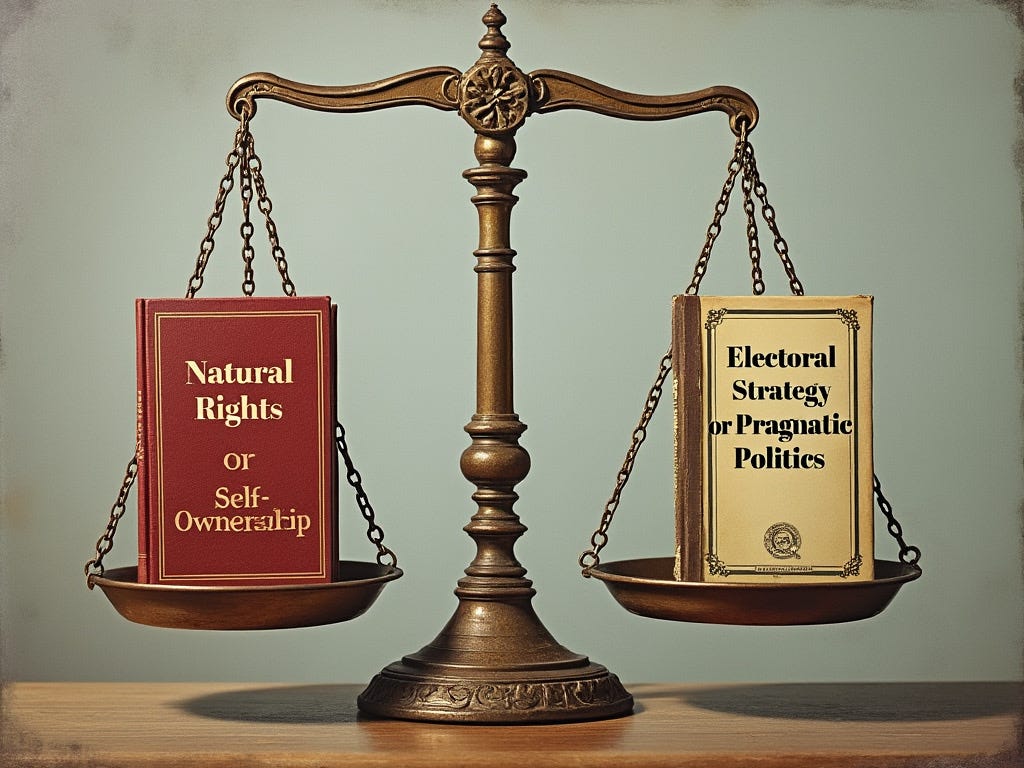
The foundation of Libertarianism is built on the philosophy of natural rights, which is derived from the principle of self-ownership.
Is Libertarianism simply a legal or political philosophy, or is it first a moral one? This small question represents an oceanic divide in the general liberty movement, but specifically concentrated within the Libertarian Party.
Movers and shakers of the movement have long been left confused and distraught over the bitterness libertarians feel for each other, based on what a casual observer might view as minor differences.
My hope is this essay will help to define the issue and offer a solution. The answer lies in definition.
I don’t believe it is important for the purposes of this writing to give an LP history lesson, but to frame the conflict, it can be helpful to explain that the party was created as a means to use the platform of electoral politics as a means to create an activist movement to ignite a radical cultural shift in the United States of America. The intent was to create a movement.
Time and momentum naturally brought interest and competing ideas. Near the midway point of the first decade of the current century, the party saw a change as a sea of more pragmatic members had taken over the party. The idea that a political party “solely exists to run candidates and win elections” was born. This would evolve into the Sarwarkian wing of the party.
The early members were revolutionary activists and thinkers who were attempting to use the political process as a means to reach a captive audience with extreme messaging. We will call these the Rothbardians.
The Rothbardians are made up of anarchists or strict minarchists, and a slightly higher percentage of culturally conservative libertarians who typically agree the federal government shouldn’t exist, and if any government at all should, its sole purpose is to defend the natural rights of individuals.
The Sarwarkians, named after divisive and unpopular former chair Nick Sarwark, take a vastly different view of the party.
It is their belief that the party should distance themselves from the radical views of the Rothbardians and craft a more conventionally palatable message that appeals to more moderate members of the two main American political parties, or as they refer to them: The Uniparty.
The Sarwarkians attempted to slice the extreme messaging from the platform; instead of screaming “abolish drug laws and eliminate taxation,” they adopted the more family-friendly “regulate marijuana like wine” agenda, which retired the abolitionist agenda based on the principle of self-ownership in favor of the more pragmatic “legalize, regulate, and tax (the socially acceptable) marijuana” initiative. This is a real-world example meant to illustrate the differences of the antagonists.
The Sarwarkians believed they could become a politically relevant party by offering something for everyone. They would win disaffected Democrats and Republicans by being “socially liberal and economically conservative.”
The mantra was “everyone is a libertarian, they just don’t know it yet. Let’s bring them in and show them how great we can be, ignore our principle differences until they learn how great we are. We just need their votes.”
The goal now was simply to attract candidates and run them. Their principles became secondary to their electability. A candidate’s desirability for recruitment was based on the following criteria, ranked in order of importance:
1. **Name recognition and electability**
2. **Eloquence of articulation**
3. **Ability to not drastically contradict the party platform in his official capacity.** (For instance, if a candidate was pro-drug war, pro-hot war, and pro-prison industrial complex like Bob Barr, he should stick to talking about lowering taxes for the middle class)
The Sarwarkians were drastically opposed to defining libertarianism. “Focus on where someone is a libertarian and ignore where they aren’t. We can nurture them into changing,” was the thought.
People who disagreed with this strategy or who attempted to point out inconsistencies or hypocrisies were labeled “purists and gate-keepers.”
This was a hard pill for the Rothbardian wing to swallow, and they were often the ones being chastised.
For the better part of two decades, the Libertarian Party was at odds with the greater Liberty Movement. The party was dominated by Sarwarkians and politicians. The Rothbards had gravitated to the Ron Paul movement, the Mises Institute, podcast creation, and other means of activism and education.
For years, the Libertarian Party was thought of as a hypocritical joke, leaving a bitter aftertaste.
For better or worse, the party owned the logo and the brand, and when someone described themselves as a libertarian, the illusion of an elitist New England pot smoker came to mind: someone too soft to be a Republican and too autistic to be a Democrat. To the minds of anarchy-capitalists and true minarchists, the Libertarian Party had been conquered, and the brand nearly destroyed.
While the Sarwarkian sees the Libertarian Party as a means to accomplish political goals at the ballot box by means of pragmatism and political savvy, the Rothbardian sees the Libertarian Party as a marketing engine meant to bring a bold message of an ethics-based philosophy to a captive audience, which is looking for a way to make government more efficient, while they should be learning that evil should not be taught efficiency.
Looking at the current state of the Libertarian Party, it is easy to conjure up images of Lysander Spooner and paraphrase the question: “be it one thing or another, what has it done, and does it deserve to exist?”
I believe the party does deserve to exist. Or at least can deserve to exist, but changes have to be made. The Sarwarkian model must be retired and only remain in memory as a cautionary tale. If the Libertarian Party only exists to win elections, then it has failed by every metric and should be allowed to die. Many (still an extreme minority) Libertarians have been elected to state and even federal office, but not a single one from the Libertarian Party. What does it tell us that an attempted movement that defined itself on electoral success has failed to win a single statewide election in all of its existence? Even if we get to the county level, that number would be an embarrassment, relatively speaking.
I believe the party can learn to thrive, and can be somewhat inclusive but must make some changes. It must become who it is and be comfortable with that.
The first thing is we must define what is a libertarian and come to grips with the fact that many, maybe even most people will not fit that definition, and then realize that isn’t just okay, it is good.
A foundation cannot be built on mud, and a movement cannot be made of jellyfish. People do not want to join something that cannot say what it is or what it stands for. The only people who will join the “everyone is welcome” club are the ones who aren’t welcome anywhere else.
The goal of the Libertarian Party should be to either eliminate government or, in the words of Grover Norquist, “make it so small you can drown it in a bathtub.”
If you want people to work together, you must give them actionable projects to work together on. Projects that invoke passion are projects that build movements. Libertarians are a strong, intelligent, passionate, and unique group of people. Simply handing them a petition every 4 years and telling them to oppose the other parties’ candidates (regardless of how uninspiring ours are) is not going to inspire anyone to do anything. I do not have to prove this statement; history has done it.
Is Libertarianism simply a legal and political philosophy, or is it first a moral one?
Individuals who believe libertarianism is simply a pragmatic philosophy to make government more efficient, who believe we are in a mess but with common sense solutions and good policies can vote our way out of it, should join other parties and help them recruit more liberty-minded candidates to run and win those primaries. They should act as ambassadors for the Libertarian Party to help us bridge the divide and work with those parties and use their infinite resources in an effort to elect individuals who will help swing the pendulum towards the side of liberty. They should be encouraged to work for and with local LP candidates, especially in non-partisan races. We can develop a roster of good libertarian candidates at the local level, we can foster them, train people to become used to voting for them, and grow our electoral presence, but electoral politics is not going to be an effective means of growing the Libertarian Party into a force at this juncture, but there is a place for it.
When we agree that Libertarianism is derived from the principle of self-ownership, we can begin to define ourselves based on the morality that naturally derives from that.
When we understand that no government, person, or other entity owns an individual but himself, we understand then that no government, person, or outside entity can morally aggress upon us for any reason.
When these terms are defined, there is ambiguity deleted. Understood in these terms, The Non-Aggression Principle (NAP) can no longer be bastardized to mean so much that it becomes meaningless. When we begin at the reality that we own ourselves, and no one else can own us or us them without our express desire and submission, then we understand what aggression means in these terms. You have no right to take from me what is mine against my will; doing so is an act of aggression that can trigger my right of self-defense. The first act is an aggressive one, and the second is defensive. All that follows is a river of logic. I own my labor and the fruits of my labor, which becomes my property. If you trespass upon my property, you are aggressing upon me, and I have a right to defend my property as an extension of myself. I own my words and the ability to speak them. If what I am saying offends you, you have the right to not associate with me, to leave when my presence is bothersome to you, but you have no right to use force to make me silent. My unwanted words are not an act of aggression because they do not trespass on your natural ability to do anything. An attempt at force to shut me up, however, would be an act of aggression that would warrant self-defense. Words are not violence or aggressive force. This is the concept of natural rights. When taken from the principle of self-ownership, natural rights flow logically into a law like a river into the ocean.
Let’s look at an example that sometimes confuses beginners:
Let’s say that my name is Russia, and I own a large farm. My neighbor, Ukraine, has a smaller farm, and he has been trying to convince many of his bordering neighbors to form an alliance to throw me off of my farm.
One day, I get tired of hearing the Ukrainian propaganda, and I carry a gun onto his property without his permission to give him a piece of my mind. He tells me to get off his property, or he will use guns to prevent me from speaking.
Whose natural rights are being violated in this instance? Many think my rights of free speech are being violated and/or my right to carry my weapon.
Many are wrong. In this instance, I have trespassed on Ukraine’s property, an extension of himself. He has no obligation to allow me there to speak, carry a weapon, or anything else. If he requests I leave and I refuse, he is within his rights to defend himself and his property. I made the act of aggression by trespassing on his property.
Now let’s say Ukraine calls up his friends, and I call up my friends, and we are all about to have a fight. I am winning,
But I have a bigger neighbor to the west of me who doesn’t like that; he wants to get involved as well, but he doesn’t have the guts to do it on his own, or even enough money to hire anyone to go in for him. So he steals from individuals in his community to buy guns and mercenaries, and sends them in to fight in his interest. Can this be justified? No. Regardless if the western neighbor believes his cause is just and righteous or if he is just trying to exercise a greedy land grab, it makes no difference. The people stolen from had their rights violated. It is not okay to steal from one person to help another.
I realize the Russia/Ukraine conflict isn’t as simple as “Putin invaded, and Ukraine is good,” but that’s not the point here. The point is if you want to defend your neighbor or anyone else because you believe their rights are being violated, it is reasonable for you to do so. It isn’t reasonable for you to steal from me or force someone else to do it for you.
From this example, we can see that because a violation of the non-aggression principle trespasses on the natural rights derived from the fact that a person owns himself, there is only one clear position for a Libertarian to take in matters of outside conflict: we can send ourselves, but we must be against any government taking action, even if we believe that government action will likely lead to our preferred solution. We cannot violate the natural rights of others just to benefit our own personal or collective desires.
The point of this is that there are clear and concrete principles that define libertarianism. In order for any movement to advance, it must be a voluntary collective of individuals who share a core principle.
There is no “perfect libertarian,” and there are areas of gray which preclude a test of perfection. You can disagree with me on many things and be a positive force for this movement, but it is my opinion that there are some things we must agree on to have the same goals. To be an effective messenger of liberty, the Party must exist only to protect individual property rights: self-ownership.
We are not anti-war because we are libertarians; we are libertarians because we are anti-war.
We are not against taxation because we don’t believe in community; we are against taxation because it attempts to steal from or make slaves of self-owned individuals.
We are not against prohibition because we wish to promote vices but because we recognize it is immoral for one man to tell another what he can make, buy, sell, or consume.
Libertarians must be bold messengers of extreme change.
We must also promote cultural values to complement these changes.
While we do not want a heroin addict or prostitute locked in a cage, we also may not want them driving our parades or performing for our children. Most things should be legal, but many should not be accepted. When we outsource moral responsibility to an immoral entity, the state, we wind up with what exists. What exists, in society, in government, and in the Libertarian Party, has not been working. We need a change.
The foundation of Libertarianism is built on the philosophy of natural rights, which is derived from the principle of self-ownership

.
Read the collection: Liberty & Anti-State.
Read next: Taxation Is Worse Than Theft · To The Party I Loved · Hijack the Hollow Party: A Libertarian Strategy for One-Party States.